Make your product work for the agents your customers send
Someone asks an assistant to compare three products and sign up for the best one. The assistant never sees your homepage design. It reads robots.txt, looks for llms.txt and an API, and works the forms from the markup. An agent actor uses your product the same way, through the browser, the API, the docs and your MCP servers, and reports each place it got stuck as a gap with the evidence attached.
- 01An assistant is sent a task
- 02Agent files and docs
- 03Your API and MCP servers
- 04The flow in the browser
What you get
Captures on this page are from a workspace testing Parlour, a demo app simulating a restaurant booking flow.
- 01
Know how agents score your site today
Every web project with a public address gets an Index report: the score out of 100, the categories behind it, each failing check with its weight and the frictions agents hit. If the Index does not track the domain yet, generate the report from the project; a first score runs the probes only and never lists your site on a public board.
How a score is made (opens in new tab)- Your domain
- Probes and agent sessions
- Score out of 100
The project Index report - 02
Cast an agent as the user, not a person
Mark an actor as an agent and a checklist run gives it what an autonomous agent has. Before it starts, it reads the agent-facing files on your site: robots.txt, llms.txt, the sitemap, the OpenAPI spec, the MCP server card and the agent cards. Then it works the task through the browser, plain HTTP requests to your API and the MCP servers attached to the project.
Build an actor (opens in new tab)- Agent actor
- llms.txt and OpenAPI
- API and MCP calls
One run, every way an agent gets in - 03
Read every gap an agent ran into
An agent names what got in its way as a gap: in the API, the docs, the MCP server, sign-in, the markup or discovery, each with a severity and the URL it is about. The run report lists the gaps first, then the agent files found or missing, every API call with its status and every MCP tool call, so the fix is in front of the person who owns it.
Read a run (opens in new tab)- Gap: no API docs link
- Agent files found or missing
- API and MCP calls
The agent evidence on a run report - 04
Fix it once for people and agents, then keep it fixed
For an agent run the report also audits the markup on every page: unnamed controls, images without alt text, a missing main landmark. Those are the same fixes a screen-reader user needs, so one change serves both. Put the checklist in an automation and it runs on each deploy, so a gap that closed stays closed.
Agent readiness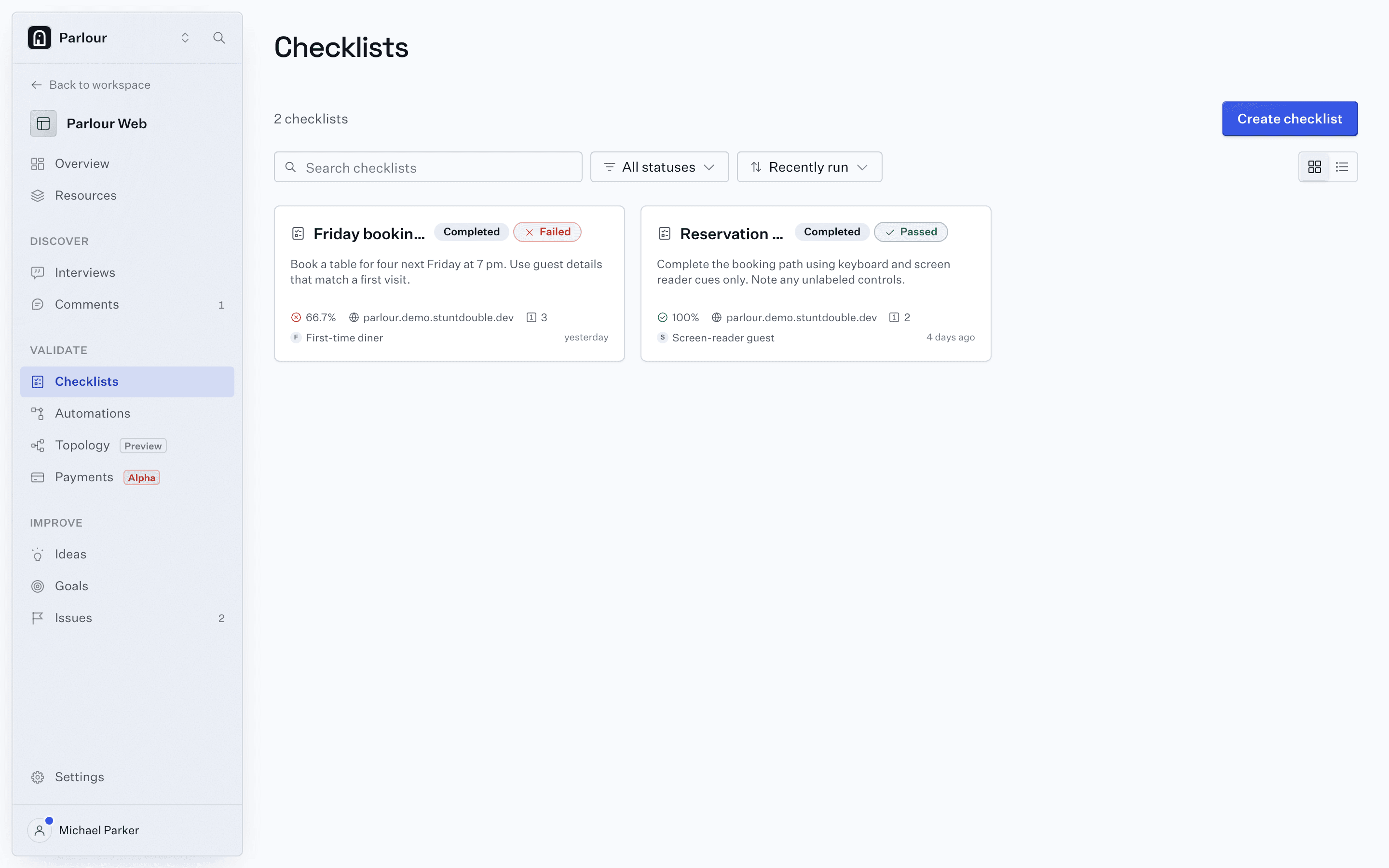
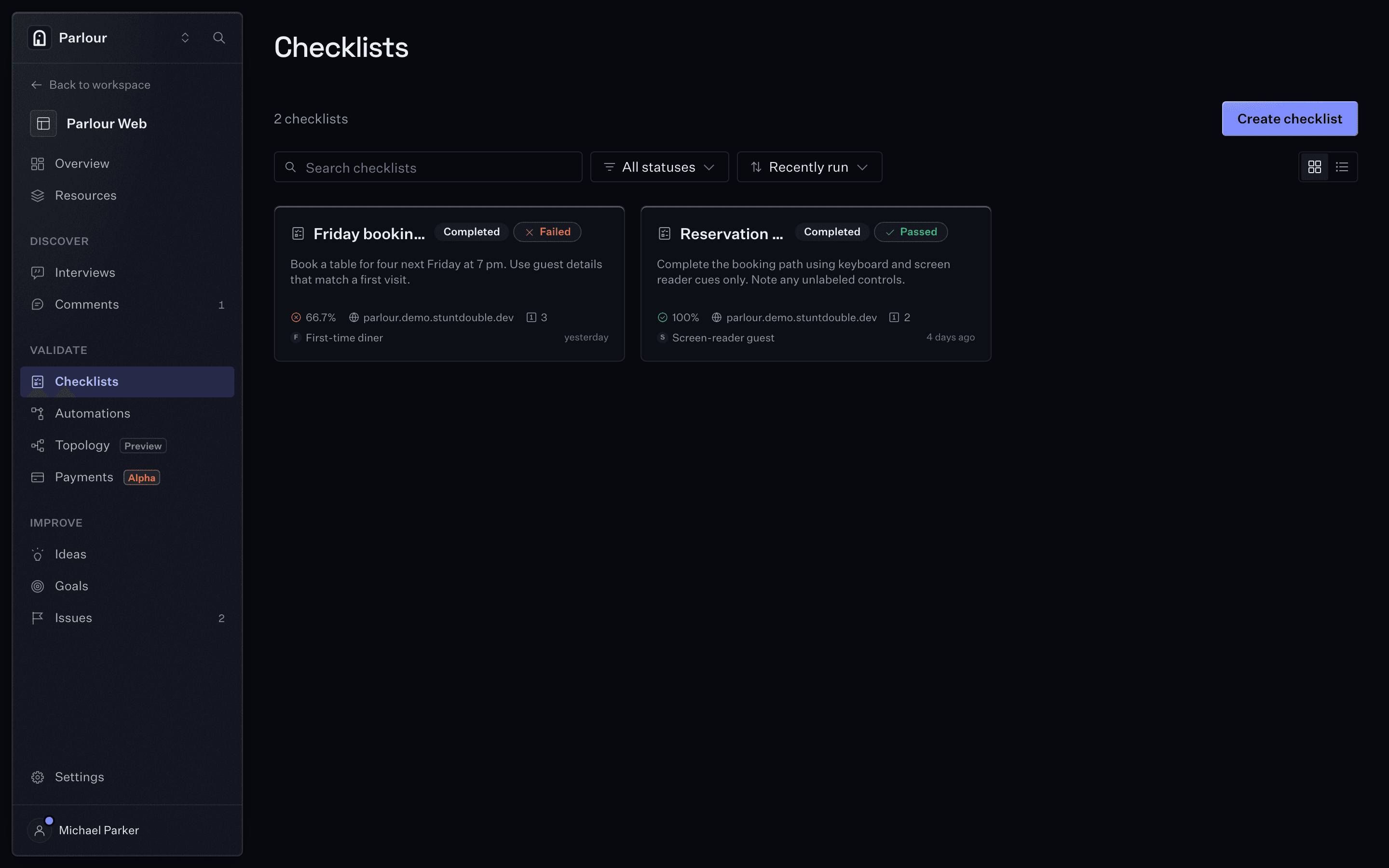
Checklists, each with the result of its last run.
Where it stops
An agent actor is one agent, and assistants read sites in different ways, so a pass is a strong sign rather than a guarantee. The API and discovery tools run in the cloud, not yet on a device, and interviews and live sessions do not use them.
FAQs
What is the difference between a persona and an agent actor?
A persona is a person driving the browser. An agent actor is an autonomous agent acting for someone: on a checklist run it also reads your agent files, calls your API and MCP servers, and records the gaps it hits as agent evidence.
Does an agent actor cost more?
No. It is on every plan and takes an actor place like a persona, and its runs are metered like any other checklist run.
Can an agent pay for something?
Agentic payments are in early access. A project's Payments page takes a request for access in the meantime.
What is the Stunt Double Index?
A public ranking of how AI agents get on with real websites. It is free to browse at index.stuntdouble.io, and every web project shows its own domain's report.
Keep reading
Go further
Try it on your own site
Give an actor your URL. It opens a real browser, works through the site, and shows you every step it took.